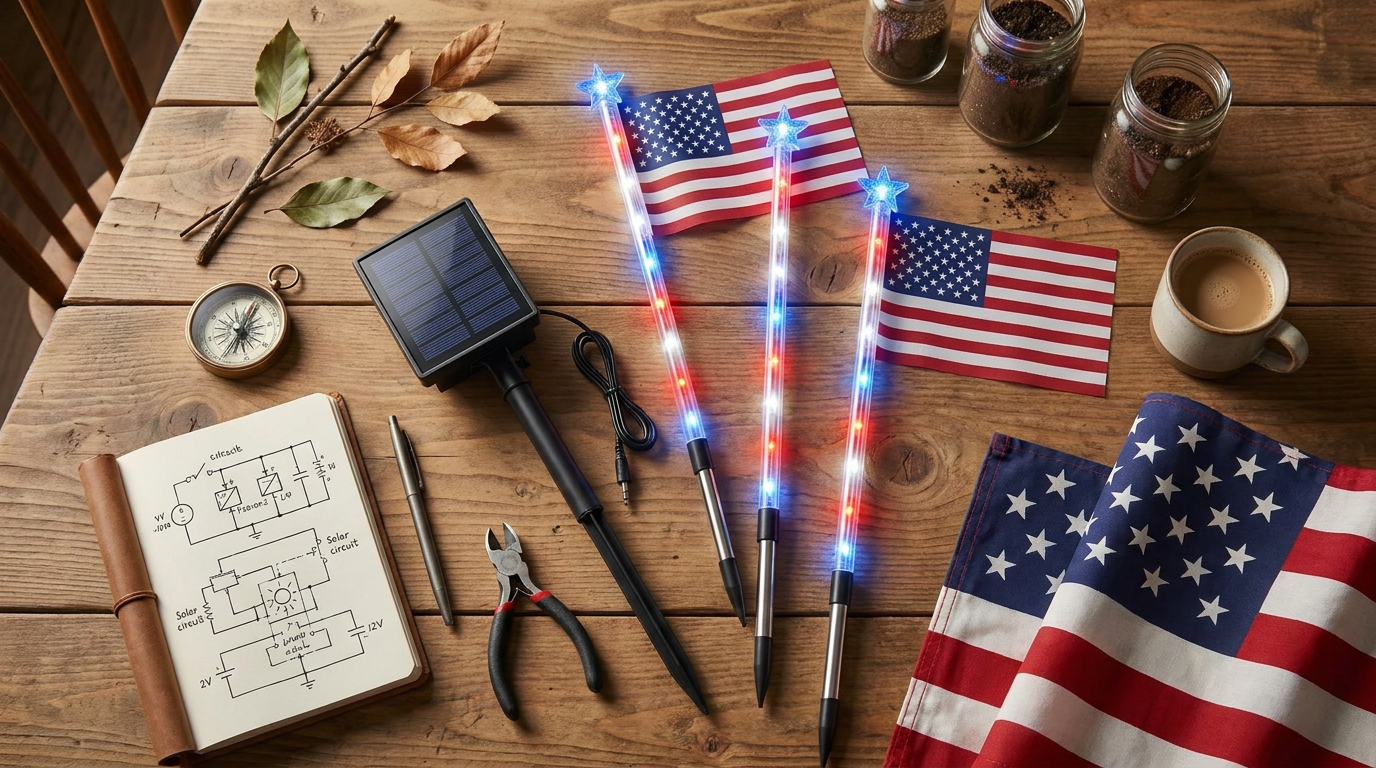
The Design Flaw That Kills Most Solar Flag Lights
 Maya ChenContributing Editor
Consumers replace their solar powered American flag lights every one or two seasons, assuming the failure is due to a cheap battery or insufficient sunlight. The conventional wisdom says to look for higher lumen counts or larger batteries. This approach ignores the fundamental engineering flaw causing the premature failure: heat.
The Thermal Failure Point
Here's the part nobody talks about: the standard all-in-one design of most solar flag lights is inherently self-destructive. Placing the solar panel directly on top of the housing that contains the lithium-ion battery creates a fatal feedback loop. The panel, designed to absorb sunlight, gets hot—often exceeding 140°F (60°C) in direct sun. This heat radiates directly into the battery compartment below.
According to Battery University, storing a lithium-ion battery at temperatures above 86°F (30°C) causes permanent capacity loss. At 140°F, this degradation accelerates dramatically. The solar panel effectively bakes the battery, reducing its ability to hold a charge season after season. The unit fails not because the panel stopped working, but because the energy storage system was cooked to death.
From Power Failure to Poor Display
Photo by Unggul Budi on Pexels
A heat-damaged battery doesn't just die; it performs poorly long before total failure. Its diminished capacity means it can no longer power the light for the required 8-12 hours overnight. The voltage output becomes unstable, causing the light to dim significantly after just a few hours of operation. This inconsistent output also affects color rendering, turning the flag's vibrant red and blue into a muddy, washed-out display.
A dimly lit or partially illuminated flag fails to meet the standards of respect outlined by the U.S. Flag Code. This is why understanding how American Flag Solarlights meet US Flag Code requirements for illumination is about more than just having a light turn on at dusk. Choosing a system with robust thermal management is the first step in ensuring a proper and respectful display. When you're deciding which American Flag Solarlights are best for your yard, prioritize designs that isolate the battery from the panel's heat.
An Engineering-First Checklist
To avoid seasonal replacements, evaluate solar powered American flag lights based on their engineering resilience, not just their marketing specifications.
- Thermal Management: Look for designs with physical separation between the solar panel and the battery housing. A detached panel or a well-ventilated, insulated compartment is a sign of superior engineering.
- Ingress Protection (IP) Rating: A minimum of IP65 is non-negotiable. This rating ensures the housing is sealed against dust and water jets, preventing corrosion that can be accelerated by heat and condensation cycles.
- Mounting Hardware: The system must withstand environmental stress. A proper 5-step setup for American Flag Solarlights relies on reinforced brackets that can handle high winds without fatiguing the housing or compromising its seals.
Why do my solar flag lights dim after just a few hours?
This is a classic symptom of battery degradation caused by heat. While the light may have received a full day of sun, the battery's maximum capacity has been permanently reduced. It can no longer store enough energy to power the LEDs at full brightness throughout the night. The initial brightness quickly fades as the damaged battery's voltage drops under load.
Are more LEDs always better for a solar flag light?
No. A high LED count is often a marketing tactic that puts excessive strain on the power system. A unit with 400+ LEDs paired with a small, heat-damaged battery will perform worse than a well-engineered system with 200 LEDs and a healthy, thermally protected power source. Focus on the integrity of the entire system—panel, battery, and housing—rather than a single, often misleading, specification.