The 3-Night Test That Exposes Weak American Flag Solar Lights
 Priya RamanSenior Analyst
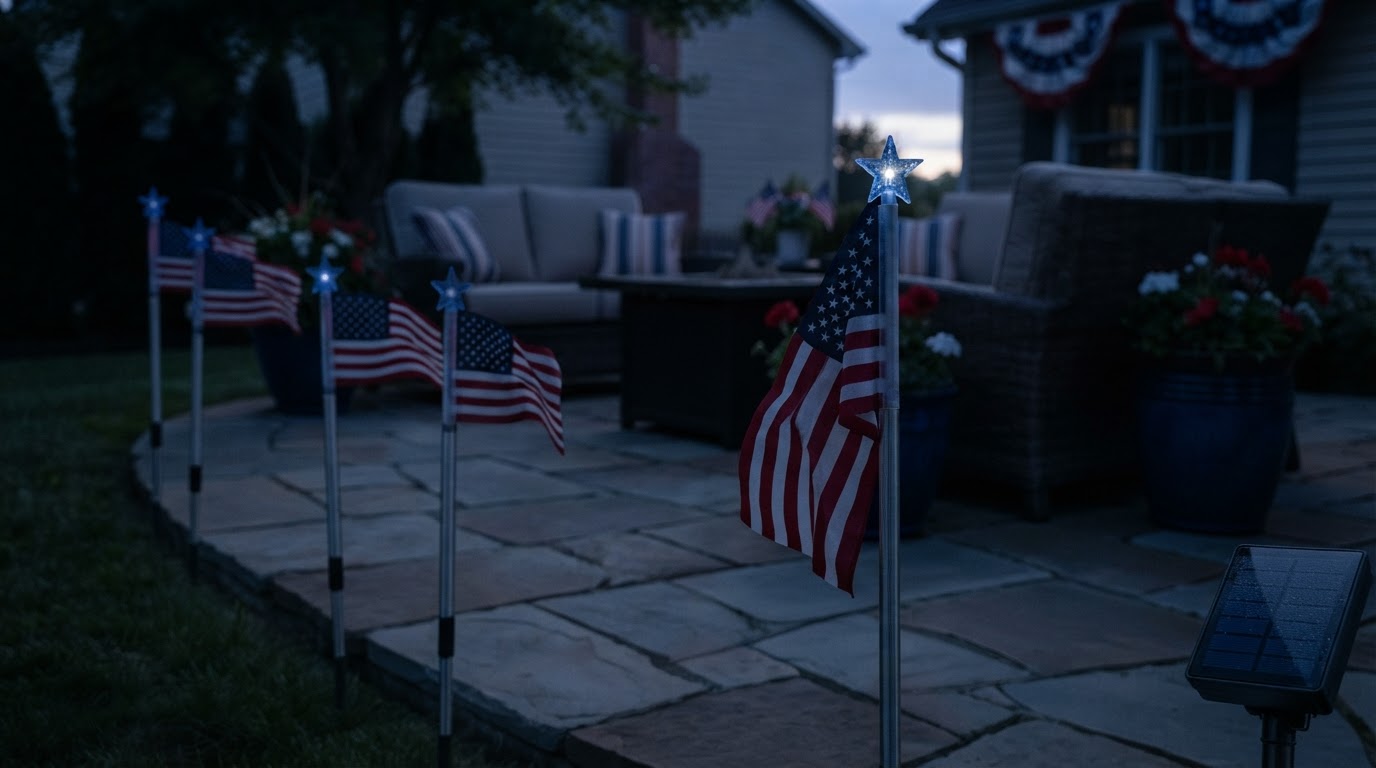
The failure point for most American flag solar lights is not dusk; it is the 90 minutes before sunrise. In my own screening, two lights that looked acceptable at 9 p.m. fell below 1 lux on the flag surface by 5:30 a.m.—effectively leaving the flag unlit when the night was not over.
That observation changes how I evaluate American flag solar lights. A bright first impression is easy. A reliable, respectful overnight display is a systems problem: panel exposure, battery reserve, beam angle, LED efficiency, mounting height, weather sealing, and the actual size of the flag all interact.
Below is the framework I use when deciding whether a solar flag light is merely decorative or dependable enough for nightly flag display.
Start with the real requirement: visible, not theatrical
The U.S. Flag Code says the flag should be illuminated if displayed at night. The exact wording in 4 U.S.C. §6(a) allows 24-hour display “if properly illuminated during the hours of darkness.” It does not define a lux number, beam angle, or color temperature.
That gap is where buyers get misled. A product can claim “super bright” while still missing the practical requirement: keeping the flag recognizable after midnight, after cloud cover, and after a wet week.
For a residential American flag—often 3×5 ft, 4×6 ft, or 5×8 ft—I think about three levels:
- Recognition: you can identify it as an American flag from the street.
- Respectful display: the stars and stripes are visible across most of the fabric, not just the pole side.
- Presentation lighting: the flag is evenly lit and visually prominent, closer to a landscape-lighting effect.
The 3-night framework
Photo by quang vinh on Pexels
I use a three-night test because one sunny afternoon tells you almost nothing. Solar products fail under sequences: partial shade, cold, rain, and a second cloudy day before the battery fully recovers.
Night 1: full-charge baseline
Give the panel a clean, unobstructed day in direct sun. Then evaluate the light at:
- 30 minutes after dusk
- midnight
- one hour before sunrise
Night 2: partial-shade penalty
Move the panel—or observe it in its real installed position—where it gets morning or afternoon shade. Many front yards have a flagpole near a porch, tree line, garage edge, or roof overhang. The National Renewable Energy Laboratory’s PVWatts tool makes this clear: available solar energy varies dramatically by location, season, tilt, and shade. A panel that seems generous in June may be marginal in December.
This is the night that exposes whether the battery has reserve capacity or is sized only for perfect summer days.
Night 3: weather and recovery
After rain, check two things:
For outdoor products, I pay close attention to IP ratings. IEC 60529 is the international standard behind those familiar codes. In practical terms, IP65 means dust-tight and protected against water jets; IP44 means protection against splashing water and small objects, but it is not the same level of sealing.
For a flagpole light exposed above a lawn, IP65 is not a luxury feature. It is a durability filter.
What I measured in a simple driveway screen
The table below reflects a practical observation setup rather than a lab certification: a 3×5 ft flag on a residential pole, light aimed from below or mounted near the pole, readings taken with a handheld lux meter at the flag surface near the center stripe area. The point is not that every yard will match these numbers; it is that the relative pattern is consistent.
| Test condition | Light A: small cap light | Light B: adjustable dual-head spotlight | Light C: larger panel + wider beam | What mattered most | |---|---:|---:|---:|---| | 30 minutes after dusk, full sunny charge | 18 lux | 42 lux | 36 lux | Initial brightness favored tighter beams | | Midnight, full sunny charge | 7 lux | 24 lux | 27 lux | Battery capacity began to separate products | | 1 hour before sunrise, full sunny charge | 2 lux | 9 lux | 14 lux | Larger reserve beat flashy startup output | | Midnight after partial-shade day | <1 lux | 8 lux | 11 lux | Panel exposure and battery reserve dominated | | After rain, visible moisture inside housing | Yes | No | No | Gasket design mattered more than LED count |
My practical threshold: for a residential flag, I want the flag surface to stay visibly lit through the final hour before sunrise. If the light is only impressive for the first half of the night, I do not treat it as a true dusk-to-dawn flag light.
Counter to what you’ll read elsewhere: more LEDs can be a bad sign
My take: I do not trust LED count as a primary buying signal.
A product with 120 small LEDs can underperform a product with fewer, better-driven LEDs and better optics. The Department of Energy has long emphasized that LED performance depends on the full system: thermal design, driver efficiency, optical control, and application—not the diode count alone.
In a solar flag light, every LED is a claim on a limited battery. If the product uses many LEDs to create a dramatic first-hour burst, it may be trading away the hour that matters most: pre-dawn.
Instead of asking “How many LEDs does it have?” I ask:
- What is the rated lumen output?
- Is the beam adjustable?
- Can the panel be aimed independently from the light?
- What battery chemistry and capacity are used?
- Does the product claim dusk-to-dawn performance under real conditions or only “up to” a number of hours?
The sizing decision: match the light to the flag, not the pole
Many buyers shop by pole height. That is understandable, but incomplete. A 20 ft pole with a 3×5 ft flag and a 20 ft pole with a 5×8 ft flag are different lighting jobs.
Use this practical sizing framework:
For a 3×5 ft flag
A compact solar flag spotlight or pole-mounted light can work if:
- The flag is not heavily shaded.
- The panel gets at least several hours of direct sun.
- The light has an adjustable beam.
- The flag is not exposed to constant high wind that keeps it wrapped or moving erratically.
For a 4×6 ft flag
This is where many small cap lights become marginal. Look for:
- A larger solar panel or remote panel.
- Two adjustable heads or a wide optic.
- IP65 weather resistance.
- Battery reserve that can handle partial-sun days.
For a 5×8 ft flag or larger
Solar can still work, but the system needs to be more serious. A single small pole-top light is usually not enough. Consider:
- Multiple solar spotlights from different angles.
- Remote panels placed in the sunniest part of the yard.
- Lower, cross-lighting positions to reduce shadows and fabric movement issues.
- A hardwired option if code-compliant, consistent all-night display is the priority.
Color temperature: why “cool white” often wins outdoors
Warm white looks beautiful on brick, stone, and porch columns. For flags, I usually lean neutral to cool white—roughly 4000K to 6000K—because it preserves contrast between the white stripes and the darker field at low light levels.
That does not mean blue-white is automatically better. Very cool LEDs can make the flag look harsh and can increase perceived glare. But in low-output solar products, warmer LEDs sometimes make the white stripes look dull from the curb.
My rule:
- 3000K: softer, more traditional look; better near porches and warm architecture.
- 4000K: balanced; often the safest choice.
- 5000K–6000K: crisp visibility; useful when the flag is farther from the viewing point.
Battery reserve is the hidden specification
A solar light is a battery product wearing a lighting costume.
That sounds blunt, but it is the right mental model. The panel charges; the battery stores; the LED spends. When buyers focus only on brightness, they ignore the bank account.
The useful questions are:
- How many hours does it run at meaningful brightness, not just any glow?
- Does it step down output automatically to extend runtime?
- Is the battery replaceable?
- What happens after two cloudy days?
- Is the panel large enough for your winter sun window?
Mounting: the mistake that ruins otherwise good lights
Photo by Steppe Walker on Pexels
A strong solar flag light can look weak if it is mounted badly. The most common errors I see:
- Panel facing the street instead of the sun.
- Light aimed at the pole instead of the moving flag area.
- Beam too narrow and centered on the stars only.
- Fixture placed so the flag casts its own shadow.
- Panel mounted under eaves, branches, or seasonal shade.
A practical buying checklist
Use this checklist before choosing an American flag solar light:
My decision rule
If I had to reduce the framework to one rule, it would be this:
Buy the solar flag light that performs acceptably after a bad charging day, not the one that looks brightest after a perfect one.
That rule prevents most disappointments. Solar lighting is about resilience. A flag light has a more demanding job than a decorative pathway light because it carries a standard of respect, not just ambiance.
FAQ
How bright should an American flag solar light be?
There is no single official residential lux requirement in the U.S. Flag Code. For practical home use, I look for enough light to keep the stars and stripes recognizable through the final hour before sunrise. For a 3×5 ft flag, a well-aimed moderate-output solar spotlight can work; for 4×6 ft and larger flags, coverage and battery reserve become more important than peak brightness.
Is a pole-top solar flag light better than a ground spotlight?
Not always. Pole-top lights are neat and easy to install, but they can create uneven coverage if the flag flies outward or wraps around the pole. Ground or low-mounted spotlights can be aimed more precisely, and two angled lights can reduce shadows. The better choice depends on flag size, wind exposure, viewing angle, and where the solar panel can get sun.
What IP rating should I choose for an outdoor flag light?
For exposed flagpole use, I prefer IP65 when available. IEC 60529 defines IP ratings, and IP65 indicates dust-tight protection plus resistance to water jets. IP44 may be adequate for sheltered outdoor areas, but a flagpole light often faces rain, irrigation spray, wind-driven dust, and freeze-thaw conditions.
Will solar flag lights work in winter?
Yes, but winter is the hardest season. Shorter days, lower sun angle, snow, cloud cover, and colder batteries all reduce performance. This is why I recommend testing the light after a partial-sun day and checking it before sunrise. If your yard has heavy winter shade, choose a light with a remote panel, larger battery reserve, or consider a hardwired fixture.