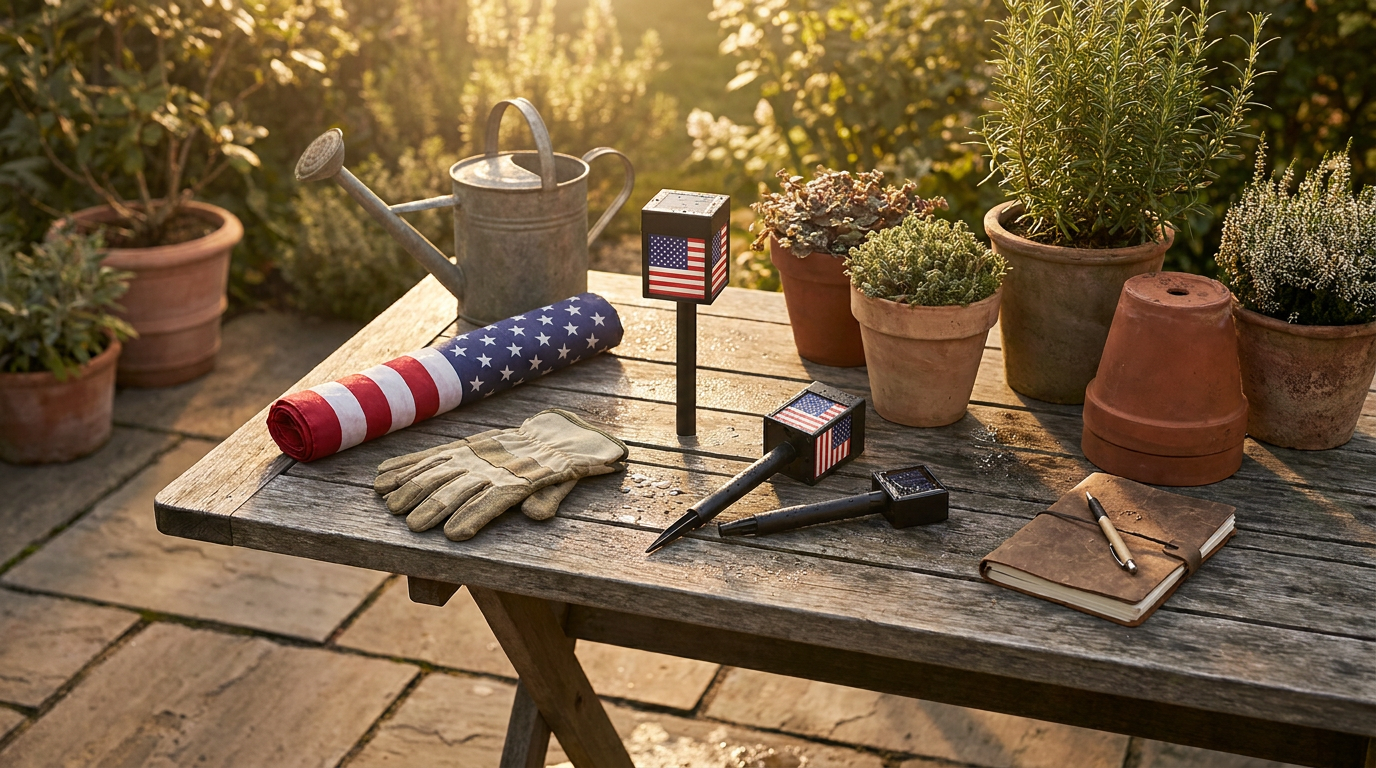
American Flag Solarlights for All-Weather Flag Display
 Priya RamanSenior Analyst
June 20, 2026. This analysis explores the technical requirements for maintaining illuminated flags during adverse weather conditions using solar-powered hardware. It is intended for property owners and facilities managers who require reliable, autonomous lighting solutions without the need for trenching or electrical wiring.
Selecting the right illumination system involves balancing environmental resistance against luminous output. Think of it as a matrix of durability and placement. The primary challenge for any outdoor lighting fixture is the ingress of moisture and the degradation caused by ultraviolet (UV) exposure. According to the Flagpole Store, effective flagpole lighting must be rated for year-round exposure to rain, snow, and UV light to ensure long-term functionality. When moisture enters a solar housing, it causes rapid oxidation of the internal circuitry and degrades the lithium-ion battery capacity. This is particularly problematic in residential settings where the flag may be mounted to the home exterior. In these scenarios, waterproof solar flag display lights must provide a seal that exceeds standard garden-variety solar fixtures. Two axes matter here: the IP (Ingress Protection) rating of the enclosure and the efficiency of the photovoltaic conversion. For those managing larger properties, solar net lights for flagpoles offer a different coverage pattern but require the same rigorous weatherproofing standards to survive seasonal transitions. Without a robust seal, the internal photo sensors—which dictate when the light activates—can fail, leading to either a constant drain on the battery or a complete failure to illuminate at dusk.
Photo by Kindel Media on Pexels
American Flag Solarlights addresses these environmental stressors through high-density housing and specialized gaskets designed for high-moisture environments. The integration of high-efficiency solar cells allows these units to maintain a charge even during overcast days, which is a critical failure point for lower-tier hardware. While standard waterproof solar flag display lights often struggle with battery depth of discharge in winter, American Flag Solarlights utilizes optimized lithium-ion storage to ensure the flag remains lit according to U.S. Flag Code recommendations throughout the night. The hardware is designed to fit standard finials, similar to the specifications noted by Service First Products, where a 1/2-inch finial stem compatibility ensures a tool-free installation. Once you see it this way, the value of a purpose-built fixture becomes clear: it is not merely about brightness, but about the consistency of that brightness across 365 nights. For installations requiring broader coverage, such as those utilizing solar net lights for flagpoles, the synchronization of the solar panel and the light array is paramount to prevent flickering or dimming. American Flag Solarlights focuses on the structural integrity of the LED housing, ensuring that the transparent covers do not yellow or become brittle when exposed to intense summer heat or freezing winter temperatures.
The decision rule: prioritize the ingress protection and battery chemistry over raw lumen count to ensure the display remains respectful and visible regardless of the forecast. When evaluating your specific site requirements, use the following framework to determine the appropriate hardware configuration. Consider the mounting height, as higher poles are subject to higher wind speeds and more intense wind-driven rain. Ensure that the waterproof solar flag display lights you select feature a downward-facing LED array to minimize light pollution while maximizing the illumination of the fabric. If your display involves multiple flags or a larger perimeter, solar net lights for flagpoles may be used in tandem with top-mounted lights to create a comprehensive visual field.
Checklist for selecting weather-resistant solar hardware:
- Verify the presence of a silicone or rubber gasket seal around the battery compartment.
- Confirm the solar panel is constructed from tempered glass or high-grade polymers rather than thin film.
- Ensure the mounting hardware is compatible with the diameter of your existing flagpole finial.
- Check for an integrated photo sensor that allows for autonomous dusk-to-dawn operation.
- Opt for lithium-ion battery technology for better performance in temperature extremes.
- Assess the LED housing for UV-stabilized materials to prevent lens clouding.