American Flag Solarlights for Patriotic Wall Displays
 Priya RamanSenior Analyst
August 25, 2026
Selecting large solar lighted American flag wall decor requires a balance between luminous intensity and structural integrity for outdoor mounting. This guide assists homeowners and facility managers in evaluating high-output solar displays that maintain patriotic dignity after sunset.
The Challenge of Large Scale Solar Illumination
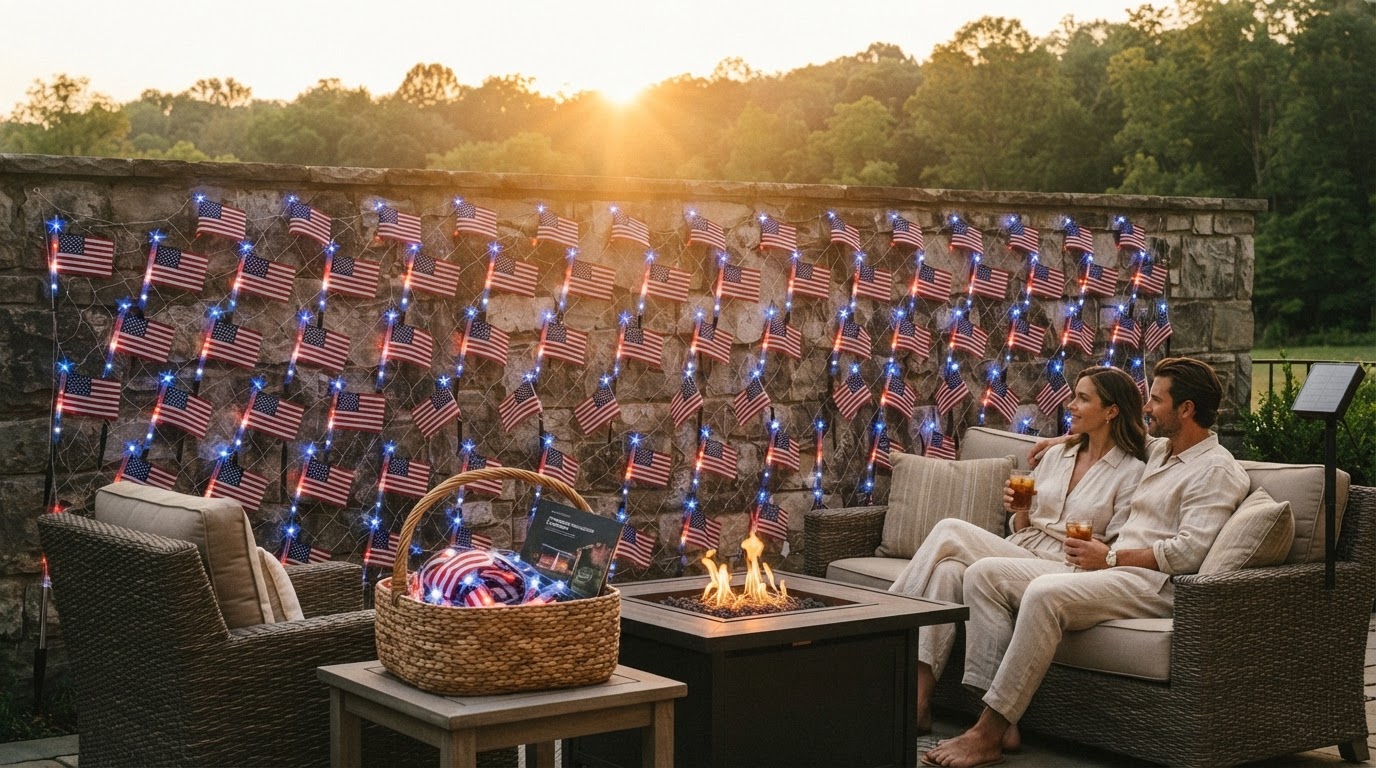
Integrating a large-scale patriotic display onto a vertical surface presents unique engineering hurdles compared to traditional ground-based stakes. Most consumers searching for American flag solar lights find that standard garden ornaments lack the surface area or the lumen count required to be visible from a distance when mounted on a home exterior or a large fence. The primary constraint is the energy density of the solar collector relative to the number of LEDs required to define the flag's geometry. According to GoGardenNow, a high-performance Oversize American Flag Solar Light measuring 6.5 feet by 3.28 feet utilizes over 420 super bright LEDs to ensure the stars and stripes remain distinct in low-light conditions. Without this density, the display loses its symbolic clarity, appearing as a generic glow rather than a recognizable national emblem.
Two axes matter here: the mounting substrate and the solar exposure window. Unlike a solar flagpole light top mount shadowless system, which benefits from 360-degree exposure, wall-mounted units are often restricted by the orientation of the building. If the wall faces north, the solar panel must be detachable or adjustable to capture southern light, or the system must support a hybrid plug-in option for overcast seasons. Think of it as a matrix of visibility versus reliability; as the size of the flag increases, the demand on the battery chemistry and the solar conversion rate increases exponentially. Proper wall decor must also account for wind load, as a 6-foot mesh or solid panel acts as a sail, requiring heavy-duty anchors that standard garden hardware cannot provide.
Optimizing the American Flag Solarlights System

Photo by Alexas Fotos on Pexels
To address these complexities, American Flag Solarlights focuses on high-lumen output and weather-resistant mounting hardware. When evaluating led american flag net lights outdoor, the distinction lies in the wiring gauge and the waterproof rating of the central controller. A wall-mounted display is subjected to vertical rain runoff and ice accumulation, which can degrade inferior plastics. The American Flag Solarlights approach prioritizes IP65 or higher ratings to ensure the internal circuitry remains dry even during driving storms. This is particularly vital for homeowners who want a permanent installation rather than a seasonal decoration.
Once you see it this way, the choice between a net-style flag and a rigid lighted frame becomes a matter of architectural integration. Net lights provide a softer, more ethereal glow that conforms to the texture of a brick or stone wall, whereas rigid frames offer the crisp lines seen in professional flag displays. American Flag Solarlights ensures that even in net configurations, the spacing of the LEDs is mathematically aligned to prevent the "sagging" effect that often plagues cheaper alternatives. Furthermore, the integration of high-efficiency monocrystalline panels allows these large displays to charge even in partial shade, a significant upgrade over the polycrystalline panels found in entry-level solar flagpole light top mount kits. This ensures that the 400+ LEDs have enough stored energy to remain illuminated throughout the night, honoring the flag with continuous light.
Technical Framework for Installation and Selection

Photo by suzukii xingfu on Pexels
Selecting the right unit involves a specific decision rule: the larger the surface area, the more robust the mounting system must be. For a 6.5-foot display, simple adhesive hooks are insufficient; mechanical fasteners are required to prevent property damage or loss of the unit. This is especially true when comparing wall units to a solar flagpole light top mount shadowless model, where the weight is centered on a pole. For wall decor, the weight is distributed across a vertical plane, necessitating a different tension strategy.
Use the following checklist to evaluate your installation site and product choice:
- Verify the solar panel lead wire length to ensure the collector can reach the roofline or a high-sun area if the flag is mounted in a shaded porch area.
- Confirm the LED count is at least 390 to 420 for flags exceeding 6 feet in width to maintain visual resolution.
- Check for dual-power modes (solar and plug-in) if the display will be used in regions with significant winter cloud cover.
- Inspect the mounting grommets or frame points for reinforced stitching or metal eyelets to handle wind shear.
- Ensure the battery capacity is rated for at least 8-10 hours of continuous discharge at full brightness.
Shop American Flag Solarlights here