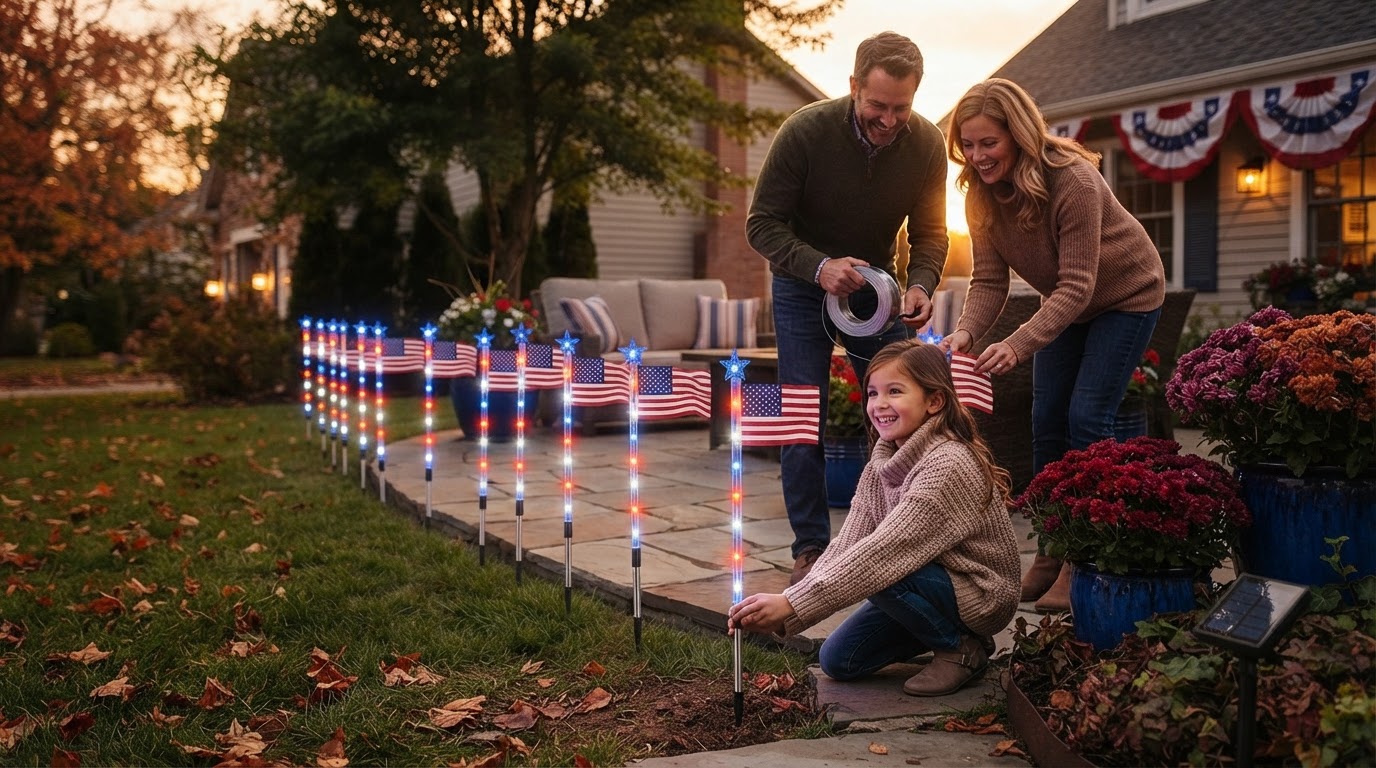
American Flag Solarlights Setup for Yard Displays
 Maya ChenContributing Editor
October 23, 2026 — The seasonal shift toward winterized landscaping has triggered a significant uptick in demand for American Flag Solarlights as homeowners seek reliable, off-grid ways to maintain patriotic displays through shorter daylight hours.
The conventional wisdom says that any solar stake will suffice for a yard display, but this ignores the specific luminosity requirements needed to actually honor the flag after sundown. According to Flags.com, adhering to the US Flag Code requires that the flag be properly illuminated if flown at night, a standard that many low-output decorative stakes fail to meet. While casual decorators often prioritize aesthetics, the technical reality of solar conversion efficiency determines whether a yard display remains visible at 3:00 AM or fades into a dark silhouette within two hours of dusk.
The 5 Technical Constants
Successful yard integration of American Flag Solarlights requires moving past the "plug and play" myth to address the specific hardware limitations of solar-powered LEDs. Run the math: a standard yard display using high-density configurations, such as the 420 LED net light models cited by Outdoor Solar Outlet, requires a significant battery buffer to sustain its 6.5 ft x 3.3 ft coverage area through an 8-hour cycle. Most consumers underestimate the impact of localized shading; even a 10% obstruction of a solar panel can lead to a 50% drop in voltage output, effectively killing the display by midnight. When selecting american flag solar lights, the focus must remain on the milliamp-hour (mAh) capacity of the internal battery and the IP rating of the housing. For a yard display to survive a standard autumn, an IP65 waterproof rating is the bare minimum to prevent internal corrosion from morning dew and frost. Furthermore, the light temperature matters; patriotic solar garden stakes that lean too far into the blue spectrum (above 6000K) tend to wash out the red stripes of the flag, whereas a neutral white allows for better color rendering. The placement of outdoor solar flag decor for garden should not just be about visibility from the street, but about maximizing the southern exposure of the photovoltaic cells.
Expert tip: Here's the part nobody talks about—the degradation of lithium-ion batteries in solar flag lights is accelerated by ground-level heat reflection. To extend the lifespan of your American Flag Solarlights, ensure the solar controller is mounted at least six inches above the soil or mulch line to allow for ambient airflow, preventing the thermal throttling that often leads to premature battery failure in outdoor solar flag decor units.
I'll change my mind when solid-state batteries become the standard for consumer-grade solar stakes, but until then, thermal management and panel orientation remain the only ways to ensure a yard display doesn't go dark prematurely.
Shop American Flag Solarlights.
Sources
- Oversize American Flag Solar Lights | 420 LED Solar + USB Flag Light
- 6 ft. Flagpole Kit with Solar Light and a U.S. Flag - Ultimate Patriot's
- Solar Lights - Solar Flag Pole Flagpole Light - Flags.com