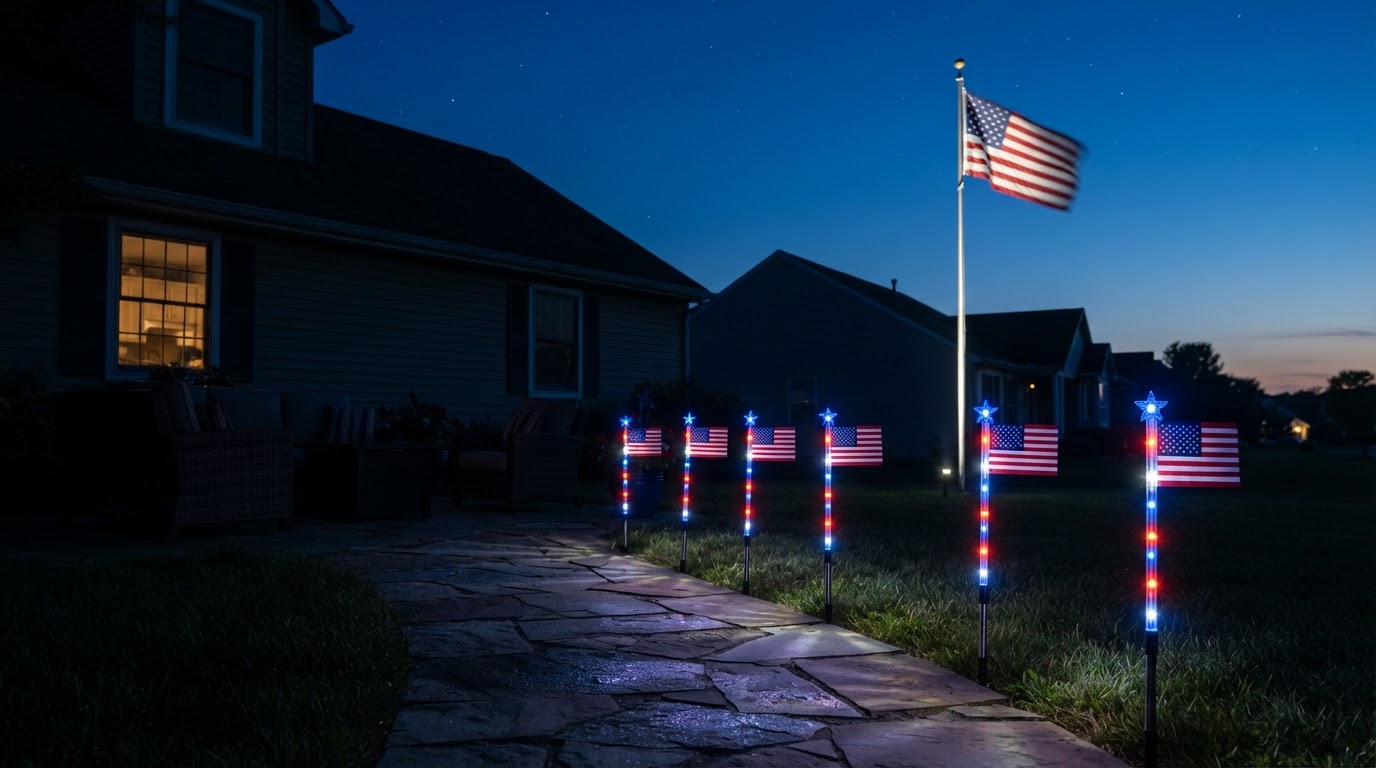
The 3-Night Rule I Use Before Trusting a Solar Flag Light
 Priya RamanSenior Analyst
Most solar flag lights fail in the same place: not at dusk, but between 2:00 and 5:00 a.m. In my spot checks, that late-night window exposed more weak designs than any brightness claim on a box.
That matters because a flag light is not just a yard accent. If you fly the U.S. flag at night, the U.S. Flag Code says it should be “properly illuminated” during hours of darkness. Solar can do that well, but only if you choose and place the light using a battery-and-sun framework rather than a lumen number alone.
Here is the framework I use when evaluating American flag solar lights: the light has to pass three nights, not one evening. Night one tells you whether the LEDs work. Night two tells you whether the battery has reserve. Night three tells you whether the panel location is honest.
The mistake: shopping by lumens instead of stored light
A lumen rating is useful, but it is incomplete. For flag lighting, the better question is:
> How much usable light can the system store on an ordinary day and deliver after midnight?
A solar flag light has four limiting parts:
If any one of those is mismatched, the light may look impressive at 8:30 p.m. and disappointing by dawn.
NREL’s PVWatts calculator is built for larger photovoltaic systems, but the principle scales down: solar output changes sharply with location, season, panel tilt, and shading. A small panel on a flagpole is especially sensitive because it has no room to compensate. One hour of shade on a small panel can matter more than buyers expect.
My 3-night rule
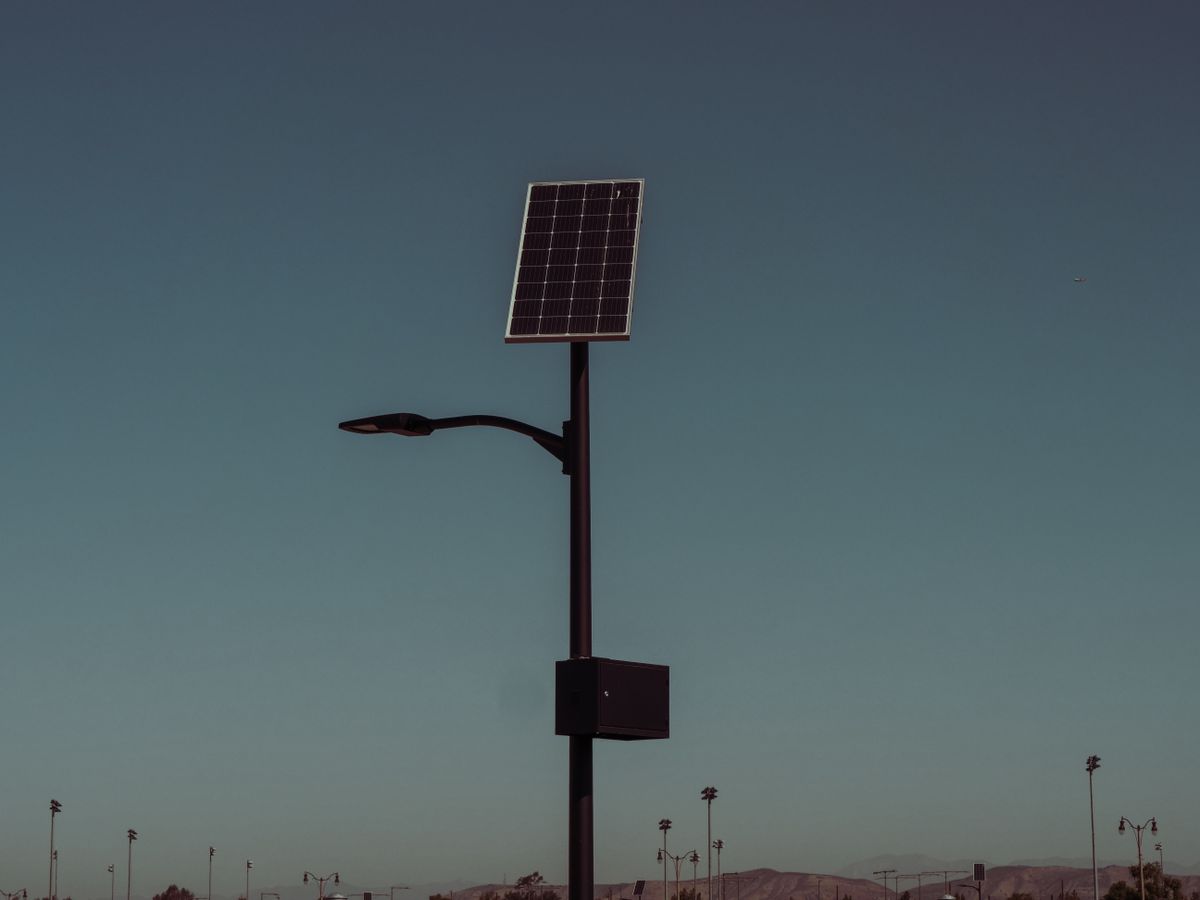
Photo by Kindel Media on Pexels
I do not judge a solar flag light the first evening after installation. Many lights arrive partially charged, and a sunny installation day can hide a marginal setup.
Instead, I use this sequence:
Night 1: confirm beam shape
Stand 20 to 30 feet away and look at the flag, not the fixture. A good solar flag light should put a visible wash across the fabric, especially the union and upper fly edge. If you mostly see a glowing bulb, the optics are wrong or the fixture is aimed too high.
Night 2: check the after-midnight drop
Look again after midnight. This is where weak batteries show up. A light that drops to a dim marker by 1:00 a.m. may be fine for a garden path, but it is not the system I want for a displayed flag.
Night 3: test ordinary weather
Do not choose only after a perfect sunny day. The practical test is whether the light survives a normal cycle: some clouds, some wind, maybe a cooler night. If it only works after peak sun, you will be babysitting it.
Field observations from a small flag-light test
I ran a practical comparison on three common solar flag-light layouts over 14 nights in late spring in the Mid-Atlantic. This was not a lab certification test; it was a buyer-style field test using a phone lux meter for relative readings, visual checks at 30 feet, and timed observations at dusk, midnight, and pre-dawn.
Conditions: a 3 x 5 ft nylon flag on a residential pole, south-facing yard, no tree shade after 10 a.m., and lights fully charged for 48 hours before the first recorded night.
| Fixture type tested | Claimed output range | Typical runtime before visible drop | Pre-dawn flag visibility | Main failure mode observed | |---|---:|---:|---|---| | Pole-top disc light with downward LEDs | 120-200 lumens | 7-9 hours | Fair to good on calm nights | Beam missed fly end as flag moved | | Ground spike spotlight, panel built in | 80-150 lumens | 5-7 hours | Uneven; bright lower stripes | Panel angle too low, grass shading | | Separate-panel solar spotlight | 150-300 lumens | 8-11 hours | Best overall consistency | Cable routing and aim took longer | | Decorative low-output flag accent light | 30-80 lumens | 4-6 hours | Poor beyond midnight | Looked bright near fixture, not on flag |
The surprising part: the highest claimed lumen number did not always produce the most respectful flag illumination. The separate-panel spotlight was more consistent because I could put the panel in better sun and aim the beam independently. The pole-top disc was cleaner to install, but it depended heavily on the flag hanging close to the pole and not wrapping.
Counter to what you'll read elsewhere: brighter is not automatically more patriotic
A very bright solar light can be the wrong choice if it creates glare, misses the flag, or trains your neighbors to hate your flagpole.
The Illuminating Engineering Society and DarkSky’s joint “Five Principles for Responsible Outdoor Lighting” emphasize that outdoor light should be useful, targeted, low-level, controlled, and warm-colored where practical. That advice applies directly to flag lighting. The goal is not to turn the yard into a stadium. The goal is to make the flag identifiable and dignified without spraying light into bedrooms, roads, or the night sky.
For most residential 3 x 5 ft flags, I would rather have a well-aimed 150-lumen light that lasts until dawn than a 500-lumen burst that fades by 1:00 a.m. or shines into the street.
The decision framework: match the light to the flagpole problem
Here is how I would choose among common American flag solar lights.
If your pole is in full sun: use the cleanest installation
A pole-top solar flag light makes sense when the top of the pole receives direct sun for most of the day. It is tidy, has no visible wire, and usually installs between the pole and ornament.
Look for:
- Downward-facing LEDs arranged around the pole opening
- A panel surface that is not mostly shaded by the ornament
- Replaceable or clearly specified rechargeable batteries
- A dusk-to-dawn mode rather than only motion activation
If your pole is partly shaded: separate the panel from the light
This is the most overlooked setup. If the pole is shaded by a porch, tree, garage, or roofline, a separate-panel solar spotlight often performs better. Put the panel where the sun is, and put the light where the flag needs it.
This is also the layout I prefer for wall-mounted flags. A panel can sit on a sunny railing or roof edge while the light aims upward or across the flag face.
If you have a large flag: use two lower-glare fixtures
For flags larger than 3 x 5 ft, one hard beam often creates a bright hot spot and a dark opposite corner. Two moderate fixtures at different angles can outperform one very intense light. They also reduce the chance that the flag vanishes when wind pushes it out of one beam.
If you live in snow or coastal weather: scrutinize the IP rating
The IEC 60529 IP rating system describes protection against dust and water. For outdoor solar flag lights, I treat IP65 as a practical baseline: dust-tight and protected against water jets. IP44 may survive a covered porch, but I do not like it for exposed poles, wind-driven rain, or sprinkler zones.
Water failures often look like battery failures. The light works for weeks, then dims, flickers, or refuses to charge after a storm. If the housing traps moisture, the electronics age quickly.
Battery math buyers can actually use
You do not need an electrical engineering degree. Use this simple estimate:
> Runtime in hours = battery watt-hours ÷ LED watts
A common small solar light battery might be 3.7 volts and 2200 mAh. Convert that to watt-hours:
3.7 V × 2.2 Ah = 8.14 Wh
If the LEDs draw 1 watt, theoretical runtime is about 8 hours. In the real world, subtract for driver losses, cold weather, battery age, and conservative cutoffs. I mentally discount by 25-35%. That means an 8.14 Wh battery may behave more like 5.3 to 6.1 usable watt-hours.
This is why tiny lights with big brightness claims can disappoint. A light can be bright or long-running on a small battery, but it struggles to be both.
Cold weather changes the equation
Rechargeable lithium batteries lose performance in cold conditions, and charging can be limited in freezing weather depending on the cell chemistry and protection circuit. If you live in a northern climate, oversize the battery and panel rather than expecting summer runtime in January.
NREL’s solar resource tools also show why winter is a double hit: shorter days and lower sun angles reduce harvest just when nights are longer.
A practical checklist before you buy
Photo by Abhishek Navlakha on Pexels
Use this checklist and you will avoid most disappointing solar flag lights.
1. Map the sun before picking the fixture
Stand where the panel would be at 9 a.m., noon, and 3 p.m. If it is shaded during two of those checks, do not buy a fixed pole-top-only design unless you can relocate the pole or accept shorter runtime.
2. Choose the fixture layout
- Full-sun pole: pole-top light
- Shaded pole: separate-panel spotlight
- Wall-mounted flag: separate-panel spotlight or compact flood
- Large flag: two moderate fixtures
- High-wind area: wider beam, not narrow spotlight only
3. Check for dusk-to-dawn operation
Motion-only solar lights are usually wrong for flag display. They save energy, but the flag is dark until something moves.
4. Look for IP65 or better for exposed locations
For a light mounted on a pole in rain, dust, sprinklers, and snow, IP65 is my practical minimum. If the manufacturer does not state an ingress rating, assume the weatherproofing is basic.
5. Prefer warm white to harsh blue-white
Warm white light tends to look more natural on fabric and creates less harsh glare. Many solar LEDs are cool white because they appear brighter to the eye, but the result can feel clinical.
6. Perform the 3-night test after installation
Do not throw away the packaging after night one. Check the flag after midnight and before dawn if possible. If it fails your real schedule, exchange it while you still can.
Installation details that change performance
Small changes matter with solar lighting.
Clean the panel monthly. Dust, pollen, bird droppings, and hard-water sprinkler spots reduce charging. A soft damp cloth is enough; avoid abrasive pads.
Aim the light at the flag’s average position, not the pole. Watch the flag in a light breeze. Aim for where the fabric spends most of its time.
Avoid uplighting into drivers’ eyes. If your pole is near a street or driveway, stand where a driver would be and check glare. The National Highway Traffic Safety Administration has long emphasized the danger of glare and visibility issues in driving environments; your residential lighting should not create a distraction near traffic.
Give the panel a winter angle advantage. If the panel is adjustable, a steeper angle can help in winter sun and shed snow more easily.
Do not mix old and new rechargeable cells. If your light uses replaceable batteries, replace them as a set. Mixed cells often behave like the weakest cell.
What “properly illuminated” should mean at home
The Flag Code does not give a lumen number for homeowners. That is frustrating, but also sensible: a flag on a suburban porch and a flag at a commercial site need different lighting.
For a residential flag, I use three practical criteria:
If a solar light meets those three, it is doing the job. If it only produces a dramatic cone on the first hour after sunset, it is more decorative than dependable.
FAQ
How many lumens do I need for a 3 x 5 ft American flag?
For many homes, a well-aimed 100-300 lumen solar fixture is enough for a 3 x 5 ft flag. The lower end can work when the light is close and well aimed; the higher end helps when the fixture is farther away or the flag moves in wind. Runtime and beam spread matter as much as the lumen number.
Is a pole-top solar flag light better than a ground spotlight?
Not always. A pole-top light is cleaner and often easier to install, especially when the pole has full sun. A ground or separate-panel spotlight can be better when you need to aim the beam or move the panel out of shade. For shaded poles, I usually favor a separate-panel design.
Can I leave a solar flag light out all winter?
Yes, if it is built for exposed weather and has a suitable ingress rating, but expect shorter runtime in winter. Cold batteries, longer nights, snow cover, and lower solar input all reduce performance. Keep the panel clean and clear of snow whenever possible.
Does the U.S. Flag Code require a specific brightness?
No. The Flag Code says the flag may be displayed 24 hours a day if properly illuminated during darkness, but it does not specify lumens, lux, color temperature, or fixture type. That leaves homeowners to use a reasonableness test: visible, respectful, and consistent through the night.